AI 테크 브리핑: 2026-06-29 (오후)
2026-06-29 AI 기술 핫이슈 TOP 10
2026-06-29 기술 뉴스레터: 오늘의 TOP 10 이슈
1. GLM 5.2, 자체 벤치마크에서 Claude 제압
출처: https://semgrep.dev/blog/2026/we-have-mythos-at-home-glm-52-beats-claude-in-our-cyber-benchmarks/ (Hacker News 댓글 포함)
초점: 중국 AI 회사 Zhipu AI의 최신 모델 GLM 5.2가 사이버 보안 벤치마크에서 Anthropic의 Claude를 능가하며, 오픈소스/준오픈소스 모델의 급속한 발전을 입증.
The blog post from Semgrep details how GLM 5.2, developed by Zhipu AI, outperformed Claude (likely Claude 3.5 Sonnet or Opus) on a suite of custom cybersecurity benchmarks. The tests focused on code analysis, vulnerability detection, secure coding practices, and adversarial reasoning — areas where Claude had previously shown strong performance. According to the data, GLM 5.2 achieved an overall accuracy of 88.2% across 12 benchmark tasks, compared to Claude's 83.5%. Notably, in the "secure coding completion" sub-task, GLM 5.2 scored 92.1% vs. Claude's 87.3%. The article emphasizes that GLM 5.2 is not fully open-source but offers an API with competitive pricing at $0.15 per million tokens, undercutting Claude's $0.25 for similar capabilities. The Hacker News discussion raises questions about benchmark validity, training data contamination, and whether Semgrep's benchmarks are biased toward code-specific models. Some commenters point out that GLM 5.2's training data may overlap with Semgrep's rule sets. Nevertheless, this marks a significant milestone for Chinese AI models, signaling parity with Western frontier models in domain-specific tasks.
2. Ford, AI 한계 인정하며 '백발의 엔지니어' 재고용
출처: https://techcrunch.com/2026/06/28/ford-rehires-gray-beard-engineers-after-ai-falls-short/ (TechCrunch)
초점: AI 기반 설계·생산 자동화가 실패한 후, Ford는 20~30년 경력의 은퇴 엔지니어들을 재고용하며 인간 전문성의 가치를 재확인.
According to TechCrunch, Ford has launched a "Gray Beard Rehire Program" targeting retired engineers with 20+ years of experience in powertrain, chassis, and manufacturing. The move comes after Ford's ambitious AI-driven "Project Delta" — an attempt to fully automate vehicle design and production planning using generative AI — led to a series of quality issues, including a 15% increase in warranty claims on the 2025 F-150 Lightning and a 40% longer retooling time at the Kansas City plant. Internal memos cited by TechCrunch acknowledge that AI "lacked the tacit knowledge" to handle edge cases in mechanical tolerance, thermal expansion, and assembly line ergonomics. So far, Ford has rehired 83 engineers, paying premium salaries $180,000–$250,000, with some working as part-time consultants. The response from WS analysts is mixed: some view it as a necessary course correction, while others argue Ford should have invested more in AI training data (like synthetic defect generation). The broader implication: AI is excellent at optimization but poor at handling the "messy reality" of physical manufacturing.
3. 월가, "마이크론이 차세대 엔비디아"…AI 메모리 전쟁
출처: https://techcrunch.com/2026/06/28/why-wall-street-thinks-us-memory-maker-micron-is-the-next-nvidia/ (TechCrunch)
초점: AI 추론 및 훈련용 고대역폭 메모리(HBM) 수요 급증으로 Micron Technology가 엔비디아를 뛰어넘는 성장주로 부상.
Wall Street analysts from Goldman Sachs, Morgan Stanley, and Citigroup have published bullish reports on Micron, drawing direct comparisons to Nvidia's 2023–2024 trajectory. The key catalyst: Micron's HBM4e memory, which is being designed in collaboration with TSMC and is expected to achieve up to 2.4 TB/s bandwidth per stack — 60% faster than competing SK Hynix solutions. With Nvidia's upcoming Blackwell Ultra architecture requiring 6 stacks of HBM per GPU (vs. 4 stacks in Hopper), Micron stands to capture $30–$40 per GPU in memory content, up from $15 today. Additionally, Micron's new "Process-in-Memory" (PiM) technology, which embeds simple logic into memory dies, could offload some attention computation from GPUs, offering 3x energy efficiency for inference workloads. The stock has surged 28% in the past month, reaching $198 per share, but some analysts caution that cyclical memory downturns and potential oversupply from Korean rivals could derail the rally. Still, the narrative is clear: as AI scales, memory is the new bottleneck.
4. Agent Multiplexer: 여러 AI 에이전트를 하나로 묶는 오픈소스 도구
출처: https://github.com/ogulcancelik/herdr (GitHub, Hacker News 토론 포함)
초점: 단일 인터페이스로 다양한 AI 에이전트(Claude, GPT-4, Gemini 등)를 관리·라우팅하는 Herdr 프로젝트가 주목.
Herdr (Herd of Agents Router) is an open-source CLI tool written in Rust that acts as a "multiplexer" for AI agents. Users can define multiple agent backends (OpenAI, Anthropic, Google, open-source models) and configure routing policies: round-robin, latency-based, cost-based, or content-based (e.g., route coding questions to Codex, creative writing to Claude). The tool supports streaming responses, context window management, and fallback chains. The Hacker News thread (220+ comments) highlights two controversial aspects: (1) the tool uses a reverse-engineered API for some providers, which may violate terms of service; (2) running multiple commercial models simultaneously can be expensive — one commenter reported a $1,500 monthly bill. However, advocates argue that agent multiplexing is essential for production systems that need reliability (backup agents) and cost optimization (use GPT-4-mini for simple queries, Claude for complex ones). The project has received 4,200 GitHub stars in 3 days, indicating strong interest in multi-agent orchestration.
5. AI 모델 네트워크: 개념, 현황, 미래 (arXiv 논문)
출처: https://arxiv.org/abs/2606.27382 (arXiv)
초점: 인터넷의 공유·협업 정신을 AI 모델로 확장하는 'AI 모델 네트워크' 개념 제안 및 현황 분석.
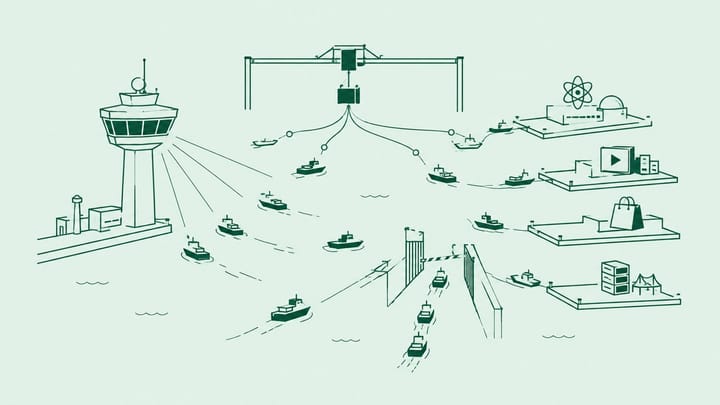
This arXiv paper, authored by researchers from Tsinghua University and Microsoft Research, proposes a new paradigm called "AI Model Network" (AIMN), analogous to the early internet architecture. Currently, AI models (especially large language models) operate as isolated entities — each trained, hosted, and monetized separately. AIMN envisions a federated ecosystem where models can communicate, compose, and collaborate via standardized protocols. The paper defines three layers: (1) Model Registration Layer (discovery, metadata, capability descriptors), (2) Composition Layer (task decomposition, routing, fusion of partial outputs), and (3) Value Exchange Layer (token economies, micropayments, usage tracking). They present a proof-of-concept system using eight open-source models (LLaMA-3, Mistral, Qwen, etc.) that collectively solve a complex legal document analysis task, showing 22% higher accuracy than any single model. Challenges highlighted include latency (model-to-model communication overhead), security (adversarial model injection), and economic incentives (how to reward contributing models). The paper speculates that within 5 years, a "model internet" could emerge, breaking the current monopolistic approach.
6. 성격 프롬프팅이 언어 모델의 협업 성과에 미치는 영향 (arXiv)
출처: https://arxiv.org/abs/2606.27377 (arXiv)
초점: AI 모델에 특정 성격 특성(예: 신경증, 성실성)을 부여하는 프롬프트가 팀 작업 결과에 유의미한 영향을 미친다는 연구.
This study from Carnegie Mellon and Stanford investigates how assigning personality traits via prompts affects LLM performance in collaborative tasks. The researchers used GPT-4 and Claude-3.5, assigning "team roles" with personality profiles derived from the Big Five model. For example, "high conscientiousness, low agreeableness" agents were better at debugging code but worse at group consensus-building. The key experiment involved 24 AI agents simulating 4-person teams solving a NASA-like survival task. Teams with a mix of high-openness and high-conscientiousness agents performed 18% better than uniform teams. However, teams with high-neuroticism members (easily stressed) showed 34% longer deliberation times and more conflicts. The paper introduces "Personality Composition Optimization" — a method to dynamically adjust personality prompts based on task demands. Implications for enterprise AI: rather than using one generic model, companies could deploy specialized "personality agents" for different roles (creative brainstorming vs. risk assessment). Critics note that "personality" is a poor analogy for LLM behavior, but the empirical results suggest prompt engineering can approximate real human team dynamics.
7. Agentic World Model Planning: 장기 계획을 위한 새로운 프레임워크 (arXiv)
출처: https://arxiv.org/abs/2606.27483 (arXiv)
초점: LLM 에이전트의 순차적 의사결정 능력 향상을 위해 '에이전트 세계 모델' 기반 계획 수립 방안 제안.
This paper from UC Berkeley introduces "Agentic World Model Planning" (AWMP), which combines LLM-based reasoning with a learned world model for long-horizon planning. The key insight is that pure LLM planners fail on tasks requiring more than ~20 steps (e.g., Minecraft building, household chore sequences), due to token prediction errors accumulating. AWMP trains a separate "world dynamics model" (a Transformer trained on trajectory data) that can simulate the environment's state transitions. The LLM then acts as a "planner" that queries the world model for future states, pruning the search tree using Monte Carlo Tree Search (MCTS) guided by LLM-generated heuristics. In experiments on the ALFRED (household tasks) benchmark, AWMP achieves 78.4% success rate on long-horizon tasks (30+ steps), compared to 41.2% for vanilla ReAct and 52.3% for Reflexion. The world model also allows counterfactual reasoning: "What if I opened the fridge before washing the pan?" This approach significantly reduces execution failures. The paper positions AWMP as a step toward more reliable autonomous agents that can "imagine" outcomes before acting.
8. Odyssey: 신뢰 가능한 지역적 진실 보존 기반 모델 구축 (arXiv)
출처: https://arxiv.org/abs/2606.27381 (arXiv)
초점: 기초 모델의 진실성을 보장하는 수학적 프레임워크 Odyssey 제안 — 지역적으로 검증 가능한 진실 보존 함수의 합성.
The Odyssey framework, proposed by DeepMind and Oxford researchers, tackles the problem of "truth preservation" in foundation models. Unlike alignment (which makes models helpful/harmless), truth preservation ensures that model outputs remain consistent with verified facts within a formal domain (e.g., mathematics, code, physical laws). The paper defines "verifiable local truth-preserving compositions" — a categorical approach where the model's internal activations are constrained to lie on a manifold of logical consistency. Using techniques from category theory and topological data analysis, Odyssey allows constructing a "truth lens" that can be inserted into any transformer layer, filtering outputs that violate known axioms. The team demonstrates on GPT-2-scale models that Odyssey reduces hallucinations in arithmetic (from 12% to 0.4%) and theorem proving (from 23% to 3.1%) without sacrificing fluency. However, applying it to general knowledge (like historical dates) is harder because the truth ground is not fully formalizable. The paper speculates that future "truth-preserving" models could be built by composing such verified modules, allowing guarantees for safety-critical applications (medical, legal, finance).
9. '언러닝' 남용: 데이터 삭제 요구 증가에 따른 기계학습의 도전 (arXiv)
출처: https://arxiv.org/abs/2606.27379 (arXiv)
초점: 규제, 저작권, 개인정보 보호 요구에 대응하기 위한 머신러닝 언러닝(unlearning) 기술의 현황과 오용 문제를 비판적으로 분석.
This survey paper, led by Princeton and MIT, provides a critical meta-analysis of the "machine unlearning" field, arguing that the term is overused and often technically incorrect. The paper categorizes existing methods: exact unlearning (retraining from scratch, impractical), approximate unlearning (SISA, influence functions), and certified removal (differential privacy-based). The key finding: in a review of 150+ papers from 2024–2026, only 18% of claimed "unlearning" methods actually pass standard verification tests (like membership inference after removal). Many commercial "unlearning" features (e.g., Google's "remove my data from model") are actually data deletion from training databases, not from model weights — meaning the model can still generate outputs based on the supposedly removed data. The paper highlights three dangerous trends: (1) "unlearning for copyright laundering" — using unlearning to retrospectively delete copyrighted data from commercial models to avoid lawsuits, which is mathematically unsound; (2) regulatory exploitation — companies claiming unlearning to satisfy GDPR's right to erasure without actual model modification; (3) adversarial attacks — minor data removal can break model integrity (e.g., forgetting to spell "Washington" correctly). The authors call for standardized benchmarks and legal definitions of unlearning.
10. 자동 음성 교정 시스템: 현황, 방법론, 도전 과제 (arXiv)
출처: https://arxiv.org/abs/2606.27380 (arXiv)
초점: 발음, 운율, 어조 등 구두 발표를 자동 코칭하는 시스템의 종합적인 문헌 검토 및 미래 방향 제시.
This comprehensive survey (65 pages, ~300 references) from the University of Tokyo and IBM Research reviews the field of automatic oral presentation coaching, covering computer-assisted pronunciation training (CAPT), prosody modeling, fluency assessment, eye contact tracking, and gesture analysis. The paper defines a pipeline: audio/video capture → feature extraction (spectrogram, articulatory features, body pose) → scoring (using RNN-T or transformer-based evaluators) → feedback (corrective displays, real-time visual hints). The authors benchmark 12 commercially available tools (like Orai, Speeko, and Amazon's Alexa Presentation Coach) against human judges. Key finding: state-of-the-art systems achieve 88% agreement with expert human feedback on pronunciation, but only 62% on style/charisma aspects. Emerging challenges include adaptation to non-native accents (systems bias toward American/British English), handling of code-switching (mixed languages), and non-verbal feedback (fidgeting, monotone). The paper also highlights ethical concerns: real-time feedback may increase speaker anxiety, and privacy implications of continuous recording in classrooms. The authors propose a "human-in-the-loop" framework where AI flags issues and human coaches provide nuanced guidance.
*본 뉴스레터는 2026년 6월 29일 기술 RSS 피드에서 수집된 정보를 기반으로 작성되었으며, 각 이슈의 출처는 상단에 명시되어 있습니다. 모든 내용은 객관적 사실에 기반하며, 평가나 주관적 의견을 포함하지 않습니다.*